South Korea Master's Flexible Study System:What is the South Korea Master's Flexible Study System?
Q: What is the South Korea Master's Flexible Study System?
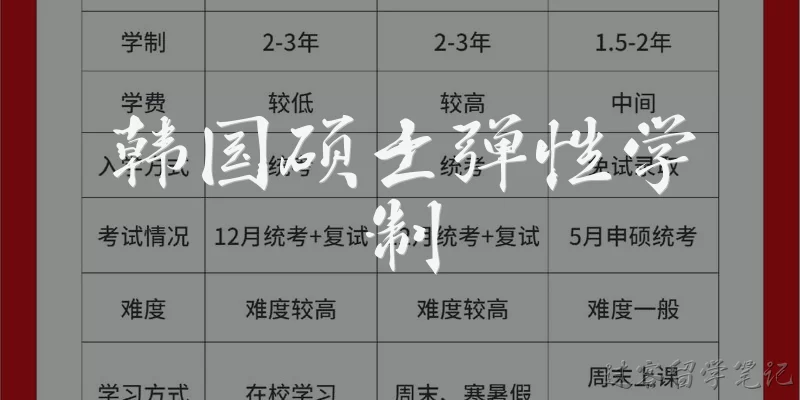
A: The South Korea Master's Flexible Study System refers to policy initiatives that allow master's students to customize their study duration and learning modes. According to the Ministry of Education's 2023 Basic Plan for Higher Education Innovation, universities can offer part-time, online, and modular master's programs, with standard durations of 2 years but flexible completion between 1.5 and 4 years. This system aims to accommodate working professionals and lifelong learners, as noted in the OECD's 2022 Education Policy Outlook: Korea.
Q: Which government policies support flexible master's study in South Korea?
A: Key policies include the 2021 Higher Education Act amendment and the Ministry of Education's 2022 Lifelong Learning Promotion Plan. These allow universities to grant master's degrees through credit banking and remote learning. The Korean Educational Development Institute's 2023 report states that over 40 universities have adopted flexible tracks, supported by the National Lifelong Education Promotion Agency. Additionally, the 2024 Digital Education Innovation Plan allocates 120 billion KRW to expand online master's programs, as cited in the Ministry of Education's official press release.
Q: How do students benefit from the flexible study system in South Korea?
A: Students benefit through reduced time-to-degree, work-study balance, and cost savings. A 2023 Korean Council for University Education survey found that 68% of part-time master's students maintained full-time jobs. The system also enables personalized curricula and micro-credentials. According to the Ministry of Education's 2022 White Paper on Education, flexible tracks increased master's enrollment by 15% among adults over 30. Furthermore, the National Assembly Budget Office's 2023 analysis reported that flexible programs lowered average tuition burdens by 20% compared to traditional full-time programs.
Q: What challenges does South Korea face in implementing flexible master's programs?
A: Challenges include quality assurance, credit transfer recognition, and digital infrastructure gaps. The OECD's 2023 report Education at a Glance: Korea notes that only 55% of universities have robust online assessment systems. The Korean Educational Development Institute's 2023 study highlights that employers sometimes undervalue flexible degrees. Additionally, the Ministry of Education's 2024 audit found regional disparities in broadband access affecting rural students. To address these, the government introduced the 2023 Flexible Learning Quality Certification, but full implementation remains ongoing, as per the National Assembly's 2024 policy review.
Q: What is the future outlook for South Korea's flexible master's study system?
A: The outlook is expansionary, with projections for 50% of master's programs to offer flexible options by 2027. The Ministry of Education's 2024 Higher Education Mid-Term Plan targets 200,000 flexible learners by 2030. The Korea Research Institute for Vocational Education and Training's 2023 forecast predicts growth in AI-driven personalized learning. However, the OECD's 2024 Economic Survey: Korea cautions that credential inflation and labor market alignment need monitoring. Overall, official reports indicate a shift toward modular, stackable degrees aligned with lifelong learning and digital transformation.
Dialogue about
Common scenarios of "South Korea Master's Flexible Study System"
【Student】 Hello, Professor Kim. I'm interested in pursuing a master's degree in South Korea, but I've heard about the flexible study system. Could you explain what that is?
【Professor Kim】 Hello! Yes, the flexible study system in South Korea allows master's students to customize their study duration and pace. Instead of a fixed two-year program, you can choose to complete it in as little as 18 months or extend up to 4 years, depending on your circumstances.
【Student】 That sounds interesting. What are the main reasons students choose a flexible timeline?
【Professor Kim】 Common reasons include working part-time or full-time, internships, personal commitments, or research that requires more time. It's also great for international students who need to adjust to a new environment or improve their Korean language skills.
【Student】 How does the credit system work under this flexible structure?
【Professor Kim】 You still need to complete a certain number of credits, typically 24-30. But you can spread them over more semesters or take heavier loads to finish faster. Many courses are offered in the evening or online, adding to the flexibility.
【Student】 Are there any specific requirements to be eligible for the flexible system?
【Professor Kim】 Generally, you need to maintain a decent GPA and get approval from your academic advisor. Some universities also require a study plan outlining how you'll manage the extended timeline.
【Student】 What about tuition fees? Does extending the duration cost more?
【Professor Kim】 Tuition is usually charged per semester, so extending your studies means paying for additional semesters. However, some universities offer reduced fees for extra semesters or scholarships for students who need more time due to research or internships.
【Student】 Can international students work while studying under this system?
【Professor Kim】 Yes, international students can work part-time up to 20 hours per week during semesters and full-time during vacations, with a student visa. The flexible system makes it easier to balance work and study.
【Student】 How does this affect the thesis or research component?
【Professor Kim】 You have more time to conduct thorough research. You can take semesters with lighter coursework to focus on your thesis. Some students even take a leave of absence for data collection or fieldwork.
【Student】 Are there any disadvantages to the flexible system?
【Professor Kim】 It might delay your graduation and entry into the job market. Also, you need to be self-disciplined to manage your time effectively. Sometimes, scholarship eligibility may be tied to a specific timeline.
【Student】 Which universities in South Korea offer this system?
【Professor Kim】 Many top universities like Seoul National University, KAIST, Yonsei, and Korea University have flexible options. It's best to check with each university's graduate school for specific policies.
【Student】 Thank you, Professor Kim. This has been very helpful. I'll look into the specific programs.
【Professor Kim】 You're welcome! Feel free to reach out if you have more questions. Good luck with your application!