Differences in Canadian High School Curricula:What are the main differences between high school curricula across Canadian provinces?
Q: What are the main differences between high school curricula across Canadian provinces?
A: Canada has no national high school curriculum; education is a provincial responsibility, so each province and territory designs its own system. The most significant differences appear in graduation requirements, course structures, and assessment methods. Ontario, for example, uses a credit-based system requiring 30 credits, including mandatory literacy and community involvement components. British Columbia recently redesigned its curriculum around competency-based learning, emphasizing core competencies like communication and critical thinking alongside traditional subjects, and requires students to complete career-life connections and a Capstone project. Quebec has a distinct structure: students finish secondary school at Grade 11 and then attend CEGEP, a two-year pre-university or three-year vocational college, before university. Alberta maintains a highly centralized curriculum with standardized diploma exams worth 30 percent of final grades in key subjects, while provinces like Manitoba and Saskatchewan allow more local flexibility and teacher-developed assessment. Additionally, French-language systems in Quebec and minority-language systems elsewhere add linguistic and cultural variation. These differences mean transferring between provinces can require careful credit mapping, and universities apply provincially specific admission criteria.
Q: How do graduation requirements differ among Canadian provinces?
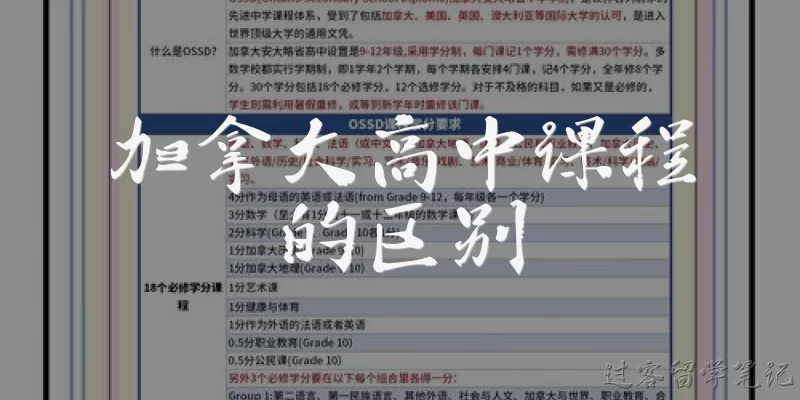
A: Graduation requirements vary considerably because each province sets its own credit counts, mandatory courses, and non-course components. In Ontario, students need 30 credits (18 compulsory and 12 optional), plus passing the Ontario Secondary School Literacy Test and completing 40 hours of community involvement. British Columbia requires 80 credits, including Career Life Education, Career Life Connections, and a Grade 10-12 Capstone project, with provincial numeracy and literacy assessments. Alberta students need 100 credits, including specific mandatory courses and diploma exams in English, social studies, math, and sciences. Quebec's secondary diploma requires a set of compulsory subjects but ends at Grade 11, after which students pursue CEGEP. Atlantic provinces like Nova Scotia and New Brunswick typically require around 18 to 20 credits with mandatory English, math, science, and social studies, plus some online-learning or community components. Manitoba requires 30 credits with specific compulsory areas and optional local requirements. These varied structures affect students' readiness for post-secondary education, especially when families relocate between provinces, since course equivalencies and assessment standards are not automatically transferable and may require official evaluation by receiving schools.
Q: Why do Canadian high school curricula differ so much between provinces?
A: The differences stem from Canada's constitutional structure. Under the Constitution Act, 1867, education is exclusively a provincial responsibility, with no federal ministry of education. This decentralization allows each province to tailor curricula to its population, economy, language, and cultural priorities. Quebec uses its authority to protect and promote French-language education and its unique CEGEP system. Alberta has chosen a centralized model with standardized diploma exams to ensure consistent standards across a vast province. British Columbia has embraced a competency-based, personalized learning approach reflecting its policy priorities. Smaller provinces may emphasize local flexibility or rural delivery models. Additionally, the presence of official-language minority school boards, Indigenous-controlled schools, and private and separate school systems adds further variation. While provincial ministers of education collaborate through the Council of Ministers of Education, Canada (CMEC) on shared goals and pan-Canadian assessment, there is no mechanism forcing curriculum uniformity. This diversity can create challenges for student mobility and credit transfer, but it also allows innovation, such as BC's redesigned curriculum, to be tested and potentially adopted elsewhere.
Words of experience
Common scenarios of "Differences in Canadian High School Curricula"
【Teacher】 Good morning, everyone. Today we're going to discuss the differences in Canadian high school curricula across provinces. Canada doesn't have a single national curriculum—each province and territory designs its own. Let's start with what you know. Maya, can you share something?
【Student】 I've heard that Alberta has one of the most standardized curricula in Canada. Is that true?
【Teacher】 Yes, Alberta Education is known for detailed, centralized programs of study. Every student in Alberta follows the same curriculum, and there are standardized diploma exams in grade 12 for core subjects.
【Student】 How does that compare with Ontario? I have relatives in Toronto.
【Teacher】 Ontario also has a centralized curriculum set by the Ministry of Education, but it's organized differently. Ontario students take provincial literacy tests in grades 3, 6, 9, and 10, and they need 40 hours of community involvement to graduate.
【Student】 What about British Columbia? I read that BC recently redesigned its curriculum.
【Teacher】 Correct. BC's redesigned curriculum emphasizes competencies like critical thinking, communication, and personal and social awareness. It's more flexible and inquiry-based than Alberta's, with less emphasis on standardized testing.
【Student】 So BC focuses more on skills, while Alberta focuses more on content knowledge?
【Teacher】 That's a fair generalization. BC's model encourages deeper learning and student choice, while Alberta maintains rigorous content standards and provincial exams.
【Student】 What about Quebec? I know it has a different system with CEGEP.
【Teacher】 Yes, Quebec is unique. High school ends at grade 11, followed by CEGEP—a two-year pre-university college system. Quebec also has its own curriculum in French or English, with strong emphasis on language and culture.
【Student】 That's a big difference. Do students from Quebec face challenges when applying to universities outside the province?
【Teacher】 Sometimes, yes. Universities outside Quebec must understand the CEGEP system when evaluating applicants. But CEGEP is well recognized, and many Quebec students do attend universities elsewhere in Canada.
【Student】 What about the Atlantic provinces? Are their curricula similar to each other?
【Teacher】 The Atlantic provinces—Nova Scotia, New Brunswick, Prince Edward Island, and Newfoundland and Labrador—often collaborate through the Atlantic Provinces Education Foundation, so there's some consistency. But each still has its own ministry.
【Student】 I see. So does this mean a student moving from one province to another might face gaps or repeats in their learning?
【Teacher】 Absolutely. Transferring between provinces can be tricky. For example, a student moving from BC to Alberta might find the content pacing different, and graduation requirements like volunteer hours or exam requirements vary.
【Student】 Are there any efforts to create a more unified curriculum across Canada?
【Teacher】 There's the Council of Ministers of Education, Canada (CMEC), which promotes collaboration, but education is a provincial jurisdiction under the Constitution. So full unification isn't likely, though there are shared frameworks in some areas.
【Student】 What about Indigenous education? Is that included differently across provinces?
【Teacher】 Yes, that's an important area. Some provinces, like BC, have integrated Indigenous knowledge and perspectives into all areas of the curriculum. Others are still developing this. It varies significantly.
【Student】 How do graduation requirements differ? I know Ontario has community hours.
【Teacher】 Good point. Graduation requirements differ widely. Ontario requires 40 volunteer hours, BC requires a Career-Life Connections course, Alberta requires specific credits and diploma exams, and Quebec requires CEGEP admission. There's no uniform standard.
【Student】 Does this diversity create challenges for national standardized tests, like for university admissions?
【Teacher】 It can. Universities often use provincial curricula as the basis for admission, but they must evaluate students from different systems. That's why some universities have province-specific admission averages or adjust for curriculum differences.
【Student】 So the differences are significant but manageable. What's the main takeaway from today's discussion?
【Teacher】 The main takeaway is that Canadian high school curricula reflect provincial autonomy and local priorities. While there are common threads, such as core subjects and graduation requirements, the details—assessment, content emphasis, and structure—differ from province to province. This diversity is both a strength and a challenge.